Pelonis Oil Filled Space Heater for Indoor Use with Adjustable Thermostat (ASIN B0HJH8Z8FC)
Best Heater Buying Guide — Black Friday Deals 2026
A useful heater choice starts with the room and the way you expect to use it, not a seasonal headline. These three indoor options cover different priorities: a compact ceramic unit with selectable heat settings, a ceramic model with a remote and stated coverage, and an oil-filled heater with three power modes and a broader listed coverage figure. Those specifications can help narrow a shortlist, but they do not guarantee a particular result in your home. For Black Friday, compare the exact product and variant shown in the offer with the features you actually need. The right pick may be the one that fits your intended space, placement, and adjustment routine—not simply the one with the most prominent claim.
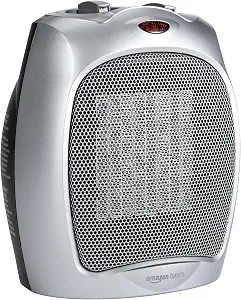
Amazon Basics Ceramic Space Heater (ASIN B07V6M3PDX)
Best Budget is the editorial label for this compact Amazon Basics ceramic space heater, based on its straightforward set of listed settings and modest dimensions—not on a price comparison. It offers High (1500W), Low (900W), or Fan Only. That selection gives shoppers a way to choose between its two stated heat settings or use the fan-only option. If your priority is a small heater with clearly described choices, these settings make the product easy to compare with other candidates. The provided facts do not establish which setting is best for a particular room, so consider your own use rather than treating a mode as a performance promise.
The unit measures 7.52″D x 6.34″W x 9.45″H and weighs 2.8 pounds. Its listed heating coverage is 161.4 square_feet. Those details are useful for checking whether its footprint fits a planned location and whether the coverage figure is relevant to the space you have in mind. The manufacturer’s stated limitation matters too: avoid using this heater in bathrooms, laundry rooms, or other high-moisture areas. That restriction should guide where you shortlist it, even if another location in your home seems convenient.
Its built-in safety features are Tip-Over Protection and Overheat Protection. These are specific features to account for, not a reason to ignore placement instructions or the moisture-area limitation. For Black Friday, the Best Budget label should not be mistaken for a claim that this is the least expensive offer; prices and promotions are not established here. Check that the listing identifies the same model and confirm that its settings, stated coverage, safety features, and use limitation match your plan. It may suit someone seeking a compact ceramic option with simple mode choices, provided the intended location is appropriate and the listed coverage aligns with expectations.
Key specs
Heat settings
High (1500W), Low (900W), or Fan Only
Safety features
Built-in Tip-Over Protection, Overheat Protection
Dimensions
7.52″D x 6.34″W x 9.45″H
Weight
2.8 pounds
Heating coverage
161.4 square_feet
Use limitation
Please avoid using this heater in Bathrooms, Laundry Rooms, or other high-moisture areas.
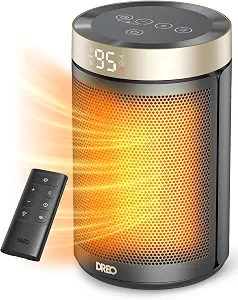
DREO Space Heater, Portable Electric Heaters for Indoor Use with Thermostat
DREO Space Heater, Portable Electric Heaters for Indoor Use with Thermostat (ASIN B0C6FCKQML)
Best Overall is an editorial fit for shoppers who want a balance of stated room coverage and convenient adjustment details. This ceramic indoor heater is listed at 1500 watts, with a PTC ceramic heating element and coverage of 200 sq.ft. Its temperature range is 41-95℉, and a remote control is included. Those facts give you a clear starting point if you are comparing a heater for a regularly used room and would value the option to adjust it without reaching the unit. They do not establish how quickly or evenly a particular room will warm, so consider the room itself as well as the listing figure.
Its listed dimensions are 6.02″D x 6.02″W x 10″H, and its weight is 3 pounds. That compact footprint may be useful when you have a defined spot in mind, while the weight is relevant if you expect to move the heater between locations. Think through where it would sit during use and whether its controls suit the way you manage warmth. The provided details support a ceramic format, remote control, and stated temperature range; they do not specify additional operating modes or safety features, so check the exact listing if those are deciding criteria rather than assuming what is included.
For Black Friday, treat Best Overall as a recommendation among these featured choices, not a measured ranking or a claim of market-wide superiority. First verify that the exact model in the offer is this one, then compare its stated 200 sq.ft coverage, remote, temperature range, and dimensions against your needs. If you rarely adjust a heater once it is set, the remote may matter less than the room fit. If remote adjustment is appealing, it gives you a concrete feature to prioritize. The strongest case for this option is the combination of listed coverage and adjustment details, with actual suitability still depending on your room and intended placement.
Key specs
Heating output
1500 watts
Heating coverage
200 sq.ft
Heating element
PTC Ceramic
Dimensions
6.02″D x 6.02″W x 10″H
Weight
3 pounds
Temperature range
41-95℉
Included accessory
Remote Control
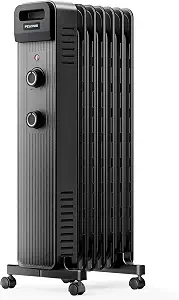
Pelonis Oil Filled Space Heater for Indoor Use with Adjustable Thermostat
Pelonis Oil Filled Space Heater for Indoor Use with Adjustable Thermostat (ASIN B0HJH8Z8FC)
Best for Broader Listed Coverage is the editorial label for the Pelonis oil-filled heater, whose stated coverage is 250 sq.ft. The figure offers a point of comparison for shoppers considering a room that calls for a broader listed coverage area than the other featured options. It is not a guarantee of warmth throughout a specific room: layout, conditions, and placement can affect what a shopper experiences, and those results are not established by the product facts. The oil-filled format is part of the product identity, so consider whether that is the type of heater you want to evaluate rather than choosing by coverage alone.
The heater has a listed output of 1500 watts and power modes of 600W/900W/1500W. An adjustable thermostat is named in the product title, while the supplied specifications also identify Overheat Protection and Tip-Over Protection. Together, those details give you concrete criteria to weigh: the available power modes, the thermostat reference, and the listed safety features. They do not describe specific thermostat increments or additional controls, so check the exact listing if you need more detail before choosing.
Its dimensions are 13.8″D x 11″W x 25.2″H, and its weight is 16.5 pounds. Compared with a compact tabletop-sized option, this calls for more deliberate planning of where the heater will live and how you would position it. That is a practical consequence of the provided size and weight, not a claim about how easy it is to move. During Black Friday, confirm that the offer is for this exact oil-filled model and assess whether its footprint, modes, and stated 250 sq.ft coverage suit the room you have in mind. The label describes its place among these recommendations; it does not prove superior real-world heating.
Key specs
Heat output
1500 watts
Power modes
600W/900W/1500W modes
Safety features
Overheat Protection, Tip-Over Protection
Heating coverage
250 sq.ft.
Dimensions
13.8″D x 11″W x 25.2″H
Weight
16.5 pounds
Start with the room’s role, not a coverage headline
Before comparing heaters, decide where one would be used and what you want it to do there. A space used for regular activities may make convenient adjustment important, while a heater intended for a specific spot may put footprint first. The listed coverage figures—161.4 square_feet, 200 sq.ft, and 250 sq.ft—are useful for screening options, but they are not promises that a heater will warm every room of that size in the same way. Room shape and the planned position are practical considerations; the supplied figures do not account for the particular conditions in your home.
Match the product’s own coverage wording to your expectations without turning it into a guarantee. The Amazon Basics model has the smallest listed coverage figure, while the DREO and Pelonis listings state larger figures. That establishes a factual distinction among these products, not a measured performance ranking. If the intended room seems close to a listing’s stated coverage, treat that as a reason to examine the exact product details carefully rather than assuming the figure settles the decision. Black Friday can put many claims side by side, but your room and use case should remain the filter.
Black Friday: verify the item behind the offer
A seasonal offer is useful only if it applies to the heater you meant to compare. Check the product name and exact model on the listing, then confirm that the details important to you appear for that item. For these choices, that could mean checking heat settings, stated coverage, included remote, power modes, dimensions, or the moisture-area warning. Do not assume that a headline or image establishes every specification. If a detail is essential and the listing does not make it clear, leave it unresolved rather than filling the gap with an assumption.
Compare the offer itself on its stated terms: the product or variant identified, what is included, and the features shown for that exact listing. No price, discount, or active promotion is established by this guide, so use the current offer information presented to you rather than relying on an expected Black Friday saving. A lower-looking headline cannot answer whether the product fits your room or routine. Keep a short priority list, such as remote adjustment or a specified power mode, and confirm those details before choosing. This makes the comparison more useful than treating seasonal timing as proof that an offer is suitable.
Give settings and adjustment the right weight
The controls you value depend on how you expect to interact with a heater. The Amazon Basics model lists High (1500W), Low (900W), or Fan Only. Pelonis lists 600W/900W/1500W power modes and has an adjustable thermostat in its title. DREO lists a temperature range of 41-95℉ and includes a remote control. These are different kinds of information, so compare like with like: modes describe stated power choices, a temperature range describes a listed range, and the remote is an included accessory.
Ask whether you tend to change settings or prefer to choose once and leave them alone. A remote may be worth prioritizing if remote adjustment matters to you; the provided facts do not say what controls it operates. A choice of power modes may be relevant if you want the listed options available, but the facts do not quantify resulting room conditions. Black Friday comparisons can make feature lists feel interchangeable. Keep the distinctions clear and check the exact listing for any control behavior that matters but is not specified here.
Plan placement around size, weight, and stated limits
A heater has to fit the spot where you intend to use it. The Amazon Basics model measures 7.52″D x 6.34″W x 9.45″H and weighs 2.8 pounds; DREO measures 6.02″D x 6.02″W x 10″H and weighs 3 pounds. Pelonis measures 13.8″D x 11″W x 25.2″H and weighs 16.5 pounds. Use those exact dimensions and weights to think through available floor or surface space and whether you expect to reposition a unit. The figures do not establish that a particular placement is safe or convenient, so account for the product instructions and your surroundings as well.
The Amazon Basics listing specifically says to avoid bathrooms, laundry rooms, and other high-moisture areas. That use limitation can rule out a planned location before any Black Friday offer comparison begins. The provided facts do not give an equivalent moisture warning for the other two products; that is not a basis for assuming suitability in wet areas. Read the instructions and listing for the exact heater you are considering, and do not treat the absence of a supplied warning as permission. Space, placement, and use restrictions belong in the shortlist alongside coverage and controls.
Treat safety features as part of the decision
The Amazon Basics heater lists built-in Tip-Over Protection and Overheat Protection. Pelonis lists Overheat Protection and Tip-Over Protection. These named features are relevant points to compare, but they do not replace careful placement or the instructions for the product. The supplied facts do not establish how a feature behaves in every situation, so avoid reading more into its name than it states. DREO’s supplied facts do not identify safety features; check its exact listing and instructions if safety specifications are a deciding factor rather than assuming details either way.
For Black Friday, include safety and location checks when confirming the exact model—not as an afterthought once an offer has caught your eye. Consider whether the intended spot follows the heater’s instructions, whether the Amazon Basics moisture-area restriction affects your plan, and which named protections are listed for the candidate. No single detail answers every household’s questions. A cautious comparison keeps documented features separate from unverified assumptions, and it gives you a clear reason to seek more information where the listing facts leave a practical question open.
Make your Black Friday choice
The best shortlist depends on the constraint that matters most in your home: the DREO’s remote and stated 200 sq.ft coverage, the Amazon Basics model’s compact dimensions and selectable settings, or Pelonis’s 250 sq.ft listed coverage and multiple power modes. Each recommendation label is an editorial guide to these particular choices, not proof of measured superiority. Before a Black Friday purchase, verify the exact model, relevant specifications, intended placement, and any unanswered questions in the listing. Let the features you can confirm—not the seasonal headline—decide which heater deserves a closer look.