Snapmaker U1 3D Printer Buying Guide — Black Friday Deals 2026
Shopping for the Snapmaker U1 3D Printer around Black Friday calls for more than watching for a changing offer. Start with the kinds of models you want to make, the materials you expect to use and the space available where the printer will sit. The listed build volume, four independent toolheads and broad named material compatibility give you concrete points to compare with your plans. Its size and weight also make placement part of the decision, rather than an afterthought.
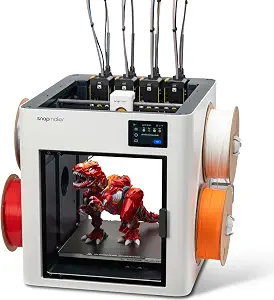
The Snapmaker U1 is a single-printer option with a 270 X 270 X 270 mm build volume, four independent toolheads and printing speeds up to 500 mm/s. Those specifications describe different parts of the choice: build volume concerns the stated space for a model, the toolheads are a distinctive listed configuration to consider against your intended workflow, and the speed figure is an upper limit rather than a promise about every print. For Black Friday shoppers, the useful question is whether those characteristics suit real projects, not whether a specification looks impressive in isolation.
Its listed dimensions are 22.6 x 13 x 14.2 inches, and its weight is 57.9 pounds. A 3.5-inch touchscreen and compatibility with PLA, PVA, TPU, PETG, PCTG, ABS, ASA, PA, PC, and more round out the supplied details. This is a good fit to consider if those named material options and the four-toolhead configuration align with what you want from a printer. During Black Friday, verify the exact U1 listing and variant before comparing offers; no particular promotion or price is assumed here.
Let your model dimensions lead the decision
The U1’s stated build volume is 270 X 270 X 270 mm. Use that figure as a planning boundary: consider the outer dimensions of the models you expect to print, including whether you usually make one larger object or several smaller pieces. A project that fits comfortably within the stated space may make this capacity relevant; an intended design that exceeds it calls for a closer look at your design plans before choosing. The specification alone does not tell you how any particular model will be arranged or printed.
A Black Friday comparison is more useful when it starts with a short list of representative projects. Check their dimensions against the stated volume rather than choosing based on an imagined future need. If your plans vary, distinguish routine models from occasional ambitions and decide which should guide the purchase. This keeps the build-space figure connected to your actual use, while leaving room to compare other details such as materials and placement.
Consider whether four toolheads match your workflow
Four independent toolheads are a prominent part of the U1’s listed specification. Their relevance depends on the work you intend to do: if the configuration is important to your planned projects, investigate how the exact listing describes it and whether it matches your requirements. If you do not have a use in mind for this characteristic, avoid treating the number alone as a reason to buy. The provided details identify the toolhead arrangement, but do not specify particular workflows or outcomes.
When reviewing Black Friday listings, keep the model name and configuration in view as you compare. A favorable-looking offer is not useful if you have not confirmed it concerns the exact U1 version you mean to assess. Write down the questions that matter to your projects, then check the product information for answers instead of assuming that a feature implies capabilities not stated in the listing. This makes the four-toolhead detail a deliberate buying criterion rather than a headline.
Choose materials from the stated compatibility list
The listed compatible materials include PLA, PVA, TPU, PETG, PCTG, ABS, ASA, PA and PC, among others. That range gives shoppers a practical starting point for checking whether the U1 fits planned material choices. If you already know which materials you expect to use, compare those names directly with the compatibility information. If you are still exploring, treat the list as a set of possibilities to investigate, not a guarantee about every material, setup or project condition.
Black Friday research can encourage quick decisions, so keep your material requirements written beside the exact product listing. Confirm that the offer you are considering is for the same product and that the relevant compatibility information is present. Do not infer extra material capabilities from the phrase “and more”; check any material not named here against the listing. This is especially useful when a specific project, rather than general curiosity, is driving the purchase.
Plan a stable place for the printer before buying
At 22.6 x 13 x 14.2 inches and 57.9 pounds, the U1 deserves a placement check before it arrives. Measure the intended spot and make sure its footprint works with the way you use that area. Also consider how you will position a printer of the listed weight; the practical answer depends on your own room and furniture, which the product facts cannot assess. Planning ahead can prevent an appealing feature list from overshadowing a basic space constraint.
As Black Friday offers come into view, compare the stated dimensions and weight with your available location before committing. Keep the measurements in their original format when checking them against the product listing, and verify you are looking at the same U1. This is a simple way to narrow choices using a real household constraint. If the intended spot is uncertain, resolve that question before letting an offer, if one appears, rush your decision.
Put speed and the touchscreen in everyday context
The U1 is listed with speeds up to 500 mm/s and a 3.5-inch touchscreen. The wording “up to” matters: it identifies a maximum stated speed, not the speed to expect for every model or job. Think about whether speed is a priority in your own printing plans, and weigh that against the more tangible questions of build volume, material compatibility and placement. The touchscreen is another listed detail to consider as part of the printer’s interface, without assuming functions beyond the fact provided.
For a Black Friday decision, avoid turning either figure into a promise about your experience. Compare the exact listing and consider which specifications affect your routine most. A shopper focused on interface details may pay attention to the touchscreen, while another may care more about whether planned models fit the stated volume. The right emphasis depends on your projects, not on a single number.
Key specs
Dimensions
22.6 x 13 x 14.2 inches
Weight
57.9 pounds
Toolheads
four independent toolheads
Build volume
270 X 270 X 270 mm
Printing speed
speeds up to 500 mm/s
Touchscreen
3.5-inch touchscreen
Compatible materials
Compatible with PLA, PVA, TPU, PETG, PCTG, ABS, ASA, PA, PC, and more
Make your Black Friday choice
Before buying the Snapmaker U1 on Black Friday, revisit your project dimensions, intended materials, interest in four independent toolheads and available placement. Then confirm that the offer is for the exact product and variant you mean to purchase, and compare the listed details rather than assuming a promotion or a particular outcome. That checklist keeps the decision grounded in the U1’s stated specifications and in the constraints that matter to you.