 Check Price on Amazon
MSI GeForce RTX 5070 Ti 16G Shadow 3X OC Gaming Graphics Card Buying Guide — Black Friday Deals 2026
A Black Friday search for the MSI GeForce RTX 5070 Ti 16G Shadow 3X OC is most useful when it starts with your planned build, not a headline deal. The listed specifications give you concrete points to check: 16GB GDDR7 memory, a PCIe 5 interface, DisplayPort and HDMI outputs, and a minimum power supply requirement of 750 W. They help narrow a shortlist, but they do not establish whether the card suits every case, display setup, or workload.
Treat Black Friday as a chance to compare the exact model and configuration you intend to buy. Confirm the product name and listed specifications, then weigh those details against your own requirements. The guide below follows that decision from system planning to the final offer check without assuming a sale price or a particular performance result.
This MSI model combines 16GB GDDR7 graphics memory, listed at 28Gbps/256-bit, with a boost clock of 2482 MHz. Its interface is PCIe 5, its outputs are DisplayPort and HDMI, and the maximum display resolution is listed as 4K UHD (3840×2160). Those are useful specifications for comparing cards against a planned system and display setup; they are not, by themselves, a promise about performance in a particular game or application.
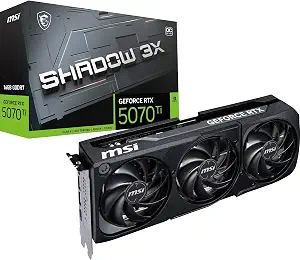
The Shadow 3X OC name identifies the model, while the specification lists three fans. For a Black Friday shortlist, that gives you details to verify on the exact product page alongside the power requirement and connections. The practical tradeoff is that a promising spec sheet cannot replace checking your own system requirements. Consider this card if its stated memory, interface, outputs, and resolution listing align with what you want to plan around, and make the final decision only after checking the exact offer and variant.
Start with the display you plan to use
Work backward from your intended screen setup. This card lists DisplayPort and HDMI outputs, so compare those connection types with the inputs on the display or displays you plan to connect. Do not assume that a connector listed on a graphics card automatically matches every cable or screen arrangement; check the equipment you will use and confirm the details for your chosen setup.
The listed maximum display resolution is 4K UHD (3840×2160). Treat that as a resolution specification, not a guarantee that every game or program will run at a particular quality or speed. If 4K UHD is part of your plan, use the figure as one point of comparison and look separately for the performance information relevant to your intended workloads. During Black Friday, comparing this resolution detail with your actual display plans can help keep the decision focused.
Set the power requirement against your build
Before weighing a Black Friday offer, check the power supply in the system you intend to use. The listed minimum is a power supply with min. 750 W. Compare that requirement with the rating on your own unit and consult the relevant system documentation before deciding that the card fits your build plan. The stated minimum is a concrete planning check, not a reason to guess about an unfamiliar system.
If a build is still being planned, make the power requirement part of the overall component decision rather than leaving it until checkout. The card’s listed requirement does not tell you what other parts your complete system will need, so assess the whole build using its own specifications. This step can prevent a tempting Black Friday listing from distracting you from a basic requirement you still need to verify.
Check the board connection in your planned system
PCIe 5 is the interface listed for this graphics card. Use that fact to compare the card with the motherboard and system you intend to use, and verify the relevant connection details in your system documentation. A shared interface label alone should not be treated as a complete compatibility check: your specific configuration still matters.
For shoppers assembling a new system, this is a useful point to settle before comparing Black Friday prices. For an existing system, identify the motherboard and review its documented support rather than relying on memory or assumptions. The aim is not to turn one specification into a blanket compatibility claim, but to make the interface a clear item on your build checklist.
Put memory and boost clock in the right context
The card lists 16GB GDDR7 graphics memory with a 28Gbps/256-bit specification, alongside a boost clock of 2482 MHz. These figures make the model easier to compare with other candidates when memory capacity and clock specifications matter to your selection. Keep each figure in its stated form, and avoid treating either one as a standalone prediction of how a particular game or creative application will perform.
Instead, write down what you need the card to do, then seek workload-specific information before deciding whether these specifications are suitable. That keeps the Black Friday comparison grounded: the listed memory and clock can help distinguish the product on paper, while your intended use and other system details determine whether it belongs on your shortlist.
Black Friday: verify the exact model before you compare
A seasonal listing deserves the same careful identification as any other purchase. Check that the selected item is the MSI GeForce RTX 5070 Ti 16G Shadow 3X OC, rather than relying on a search result or product image alone. Confirm the displayed specifications against the details you are using to make your decision, including memory, interface, outputs, and power requirement. Do not infer a discount or a particular configuration from the Black Friday label.
The listed three-fan count is another concrete detail to include in your comparison, but it does not, on its own, establish cooling behavior, noise, or results under load. Keep those questions separate from what the specification confirms. Before checking out, compare the exact item and its terms as presented, then decide whether the offer makes sense for your budget and build without assuming a price advantage.
Key specs
| Graphics memory | 16GB GDDR7 (28Gbps/256-bit) |
| GPU clock | Boost: 2482 MHz |
| Interface | PCIe 5 |
| Video outputs | DisplayPort, HDMI |
| Number of fans | 3 |
| Maximum display resolution | 4K UHD (3840×2160) |
| Minimum power supply | A power supply with min. 750 W |
Make your Black Friday choice
For this card, a sensible Black Friday decision comes down to matching its stated details to a real plan: check the 750 W minimum against your power supply, verify the PCIe 5 connection in your system documentation, and compare DisplayPort and HDMI with your intended displays. Then consider the 16GB GDDR7 specification, boost clock, listed three-fan design, and 4K UHD maximum display resolution as comparison points rather than guarantees of a particular result. Confirm the exact model and offer before buying. If those checks line up with your needs, you can judge the listing on its actual terms instead of the seasonal label.