PicassoTiles 100 Piece Magnetic Tiles, Clear 3D Building Blocks for Kids 3+ (ASIN B00AU56C5W)
Best Preschool Toy Buying Guide — Black Friday Deals 2026
Preschool toys can invite very different kinds of play: serving pretend treats, guiding a magnetic fishing game, or making structures from tiles. The right choice depends on which play idea is likely to suit the child and the household’s space and routines. This guide compares those approaches using the listed set details, not claims about performance or an active Black Friday promotion. During Black Friday shopping, check that the exact product and included components match the listing you mean to buy; an offer alone does not establish that a particular set is discounted.
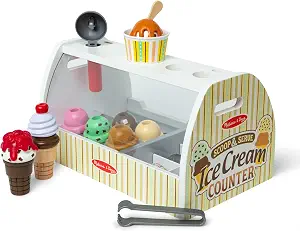
Best Overall is the Melissa & Doug Wooden Scoop & Serve Ice Cream Counter, a role-play choice for a child who might enjoy taking orders and assembling pretend desserts. Its 28-piece set includes a wooden ice cream counter, 8 scoops, 6 toppings, 2 cones, a cup, scooper, tongs, spoon, reusable menu card, and 6 bills. That collection gives the play a recognizable serving theme: a child can choose components, arrange a pretend order, and use the menu or bills as part of the scenario. Those are possibilities suggested by the pieces, not a promise about how a particular child will play.
The counter is made of wood and measures 13.43 x 7.72 x 8.7 inches. Its special ports hold the treats, and the counter also doubles as a toy storage box. Those details make the format worth considering if a family wants the play pieces gathered around a defined station rather than spread across a broad building area. The same counter may be less appealing to a child who would rather invent structures or play a tabletop game; its contents are organized around ice cream-shop pretend play. The listed age range is 36 months – 6 years, useful as a fit check when choosing for a child.
This is the guide’s Best Overall selection because its counter, serving pieces, menu, and bills combine into a clearly themed play invitation, not because the label indicates measured superiority. For Black Friday, verify that the offer is for this wooden counter set and that the included pieces match the listed 28-piece description. Avoid treating a similar product name or an offer summary as confirmation of the exact contents. Consider the counter’s stated dimensions against the intended play spot, then think about whether the storage-box feature suits the household’s put-away routine. It may be a more natural match for a child drawn to pretend service than for one whose main interest is magnetic fishing or open-ended construction.
Magnetic Wooden Fishing Game Toy for Preschoolers (ASIN B08JLSR6RN)
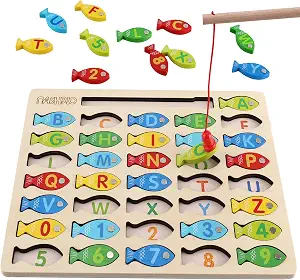
Best Budget is the Magnetic Wooden Fishing Game Toy for Preschoolers. The supplied facts identify it as a wooden, manual game for one player, with tabletop play and indoor use. Its colorful fish pieces have different letters and numbers. That makes this a distinct option for a child who is interested in picking up and matching individual pieces as part of a game-like activity, rather than building a structure or acting out a shop scene. The letters and numbers are printed on the fish pieces, so a caregiver can decide whether those details are appealing without assuming a particular learning result.
The listed dimensions are 11.8 x 8.9 x 0.6 inches. A tabletop format can be relevant when choosing where play will happen: consider whether there is a suitable surface and whether the family prefers an activity that stays in one place. The facts specify manual operation and indoor usage, so this listing describes a hands-on tabletop game rather than an electronic or outdoor activity. No age range is provided in the supplied details, so check the product listing and the child’s needs rather than inferring an age recommendation from the product name.
Best Budget is the requested editorial label for this selection; it is not a claim about a verified price or a comparison of current offers. Black Friday shoppers should check the exact item and offer details before comparing it with another toy. Confirm that the listing describes the wooden fishing game, its fish pieces with letters and numbers, and the one-player tabletop format. The label alone does not establish that a sale is active or that this is the lowest-priced choice. This game may suit a household seeking a defined, individual play activity; children who prefer pretend serving or making their own constructions may be drawn to the other styles in this guide instead.
Key specs
Material
Material Type Wood
Dimensions
Item Dimensions 11.8 x 8.9 x 0.6 inches
Players
Number of Players 1
Play location
Play Activity Location Tabletop
Usage
Indoor Outdoor Usage Indoor
Operation
Operation Mode Manual
Game pieces
colorful fish pieces with different letters and numbers
PicassoTiles 100 Piece Magnetic Tiles, Clear 3D Building Blocks for Kids 3+
PicassoTiles 100 Piece Magnetic Tiles, Clear 3D Building Blocks for Kids 3+ (ASIN B00AU56C5W)
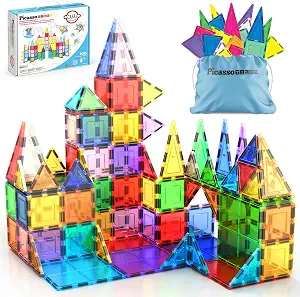
PicassoTiles 100 Piece Magnetic Tiles, Clear 3D Building Blocks for Kids 3+ is Best for open-ended building. The listed set contains 100 pieces and is made of plastic; the manufacturer recommended age is 3 years and up. Unlike a themed shop counter or a fishing game with individual fish pieces, tiles put the emphasis on assembling forms. A child can decide what to make, so the set may appeal to households looking for a less scripted building invitation. That flexibility is a description of the play format, not a guarantee of any particular creation or outcome.
The stated dimensions are 14 x 11.63 x 3.13 inches, and the item weight is 5.5 pounds. The included components list names an instruction manual. Consider the listed dimensions and weight in relation to where the set will be kept and used, especially if the plan is to bring it out on a shared surface and put it away afterward. The 3 years and up recommendation is a practical checkpoint for a gift, while the household can also consider the child’s readiness and the product’s full listing details. The supplied facts do not specify further shapes or accessories, so avoid assuming what else may be included.
The Best for open-ended building label reflects the set’s magnetic-tile format and is an editorial fit, not a tested ranking. During Black Friday, make sure the offer refers to PicassoTiles 100 Piece Magnetic Tiles, Clear 3D Building Blocks for Kids 3+ and the intended set, rather than relying on a broad search result or similar title. Check the included-components description and variant before comparing offers; this guide does not establish an active promotion, price, or savings. Choose this format if the child’s interest in making structures is a stronger draw than pretend shop play or a tabletop fishing game. If those other play ideas seem more inviting, the counter or fishing game may be the more relevant shortlist choice.
Key specs
Piece count
Number of Pieces 100
Recommended age
Manufacturer recommended age 3 years and up
Material
Material Type Plastic
Dimensions
Item Dimensions 14 x 11.63 x 3.13 inches
Weight
Item Weight 5.5 pounds
Included component
Included Components Instruction Manual
Let the play idea lead the shortlist
A useful first question is what kind of play the child tends to choose when several activities are available. The ice cream counter offers a shop scenario with scoops, toppings, serving tools, a menu card, and bills. The fishing game presents a manual, one-player tabletop activity with colorful fish marked with letters and numbers. The magnetic tiles are a building set without a single play story specified in the supplied facts. These are meaningfully different invitations, so a Black Friday shortlist can start with the play style rather than a deal headline.
Think about whether a familiar pretend situation, a defined game, or the freedom to assemble forms is the best fit for this gift. A child who enjoys directing a pretend exchange may find the counter’s menu and serving pieces more relevant than the fishing pieces. A child who likes an individual tabletop activity may prefer the fishing game’s format. A child drawn to constructing may gravitate toward the tiles. Those are ways to compare intended uses, not predictions about any child’s preferences.
Also consider how much structure feels welcome. The counter organizes its pieces around serving ice cream; the fishing game names a single-player mode and a tabletop location; the tiles are presented as building blocks. A clear theme can make it easy to imagine a play scenario, while a building set leaves the creation to the child. During Black Friday, use this distinction to narrow the products before looking at the exact offer. A low or prominent offer is not a reason to choose a toy whose play format does not suit the recipient.
Black Friday offer details worth checking
An offer should be compared against the exact product and set description, not just a general category label. For the ice cream counter, look for the wooden counter and the listed pieces, including its menu card and bills. For the fishing game, confirm that the page describes the wooden tabletop game and its colorful letter-and-number fish pieces. For PicassoTiles, check the full product name and the 100-piece set description. These checks help keep a comparison focused on the item intended, without assuming that a Black Friday promotion is active.
Product names can be similar across shopping results, so read the title and the included-components details together. If the item or variant in an offer is unclear, do not treat a headline as proof that it matches the product you shortlisted. Compare the set information shown for each candidate and resolve any difference before deciding. The supplied product facts do not establish prices, discount amounts, stock, or seller terms, so those details need to be checked in the live listing rather than inferred here.
It can also help to separate product fit from offer appeal. First decide whether a child is more likely to enjoy pretend service, a tabletop game, or building. Then review the exact Black Friday offer, if one is presented, for the matching item and set. This avoids letting a promotional label substitute for a practical choice. If two options both seem suitable, compare their stated formats and contents against the household’s intended use; do not assume that a larger set or a themed set is automatically the better fit.
Space, surfaces, and the put-away question
Think about where play can happen and what needs to happen afterward. The ice cream counter measures 13.43 x 7.72 x 8.7 inches, has special ports to hold its treats, and doubles as a toy storage box. Those listed features make the counter’s own footprint and storage role relevant to a household deciding where it will live. Check the dimensions against the available spot rather than assuming that a toy station will fit wherever a smaller tabletop activity does.
The fishing game is described as tabletop play, with listed dimensions of 11.8 x 8.9 x 0.6 inches. That makes the intended surface an important part of the decision. The tiles have stated dimensions of 14 x 11.63 x 3.13 inches and a weight of 5.5 pounds; consider whether their size and weight suit the place where the family expects to use and store the set. These figures describe the items, but they do not by themselves establish the space needed for every possible play session.
For Black Friday, avoid comparing dimensions as if they tell the whole story. The counter is a defined station with a stated storage function, the fishing game is tabletop, and the tiles are building pieces. Ask whether the household can set up the chosen play format and manage its pieces afterward. A storage feature is useful only if it matches the family’s routine; a tabletop format is useful only if a suitable surface is available. These questions can matter more than a promotional claim when deciding which toy will fit into everyday life.
Use age details and materials as fit checks
The listed age information varies across these products, so use only what is supplied and check the live listing for any additional guidance you need. Melissa & Doug gives an age range of 36 months – 6 years. PicassoTiles lists a manufacturer recommended age of 3 years and up. The provided fishing-game facts do not state an age range. Its name includes “for Preschoolers,” but that should not be substituted for a specific age recommendation. For a gift, confirm the age guidance on the product page and consider the child’s individual needs.
Materials may also shape a household’s preference, without proving that one option is better. The counter and fishing game are listed as wood, while the magnetic tiles are listed as plastic. A shopper may use that distinction as one part of a personal preference, alongside play style, size, and set contents. Do not infer additional durability, safety, or care characteristics from the material label alone; those are not established by the supplied facts.
On Black Friday, keep age and material checks separate from offer comparisons. First confirm the correct product and its stated guidance, then examine whether the offer describes the same item. For a young recipient, the counter’s stated range or the tiles’ recommended age may help narrow the choice. For the fishing game, consult its listing for age guidance rather than filling in a missing detail. This careful approach keeps the decision grounded in what is actually provided while leaving room for a caregiver to make the final household-specific judgment.
Choose the kind of repetition that feels inviting
The products offer different routes back into play. With the counter, the listed serving pieces, menu card, and bills can support repeated pretend-shop scenarios, while the treats have dedicated ports and the counter doubles as storage. With the fishing game, the fish pieces and tabletop, one-player format define the activity. With the tiles, the building-block format leaves the particular construction open. These are descriptions of the items and possible play directions, not claims about how often a child will use them.
A caregiver can consider what kind of prompt is most likely to get the child started. Does a recognizable pretend setting feel appealing, or would a defined tabletop game be easier to bring out? Would the child rather decide what to assemble? The answers may also depend on the household’s routine: some families may want a toy with a stated storage function, while others may prioritize an activity that uses a tabletop or supports building. No single format is right for every preschooler.
Use Black Friday as a time to compare the shortlisted products carefully, not as a reason to rush past these questions. Confirm the product name, variant, and included components in any offer you consider. Then return to the intended play, surface, and put-away plan. The best match is the item whose stated format and contents make sense for the recipient and home. The editorial labels in this guide distinguish the products’ intended roles; they do not establish market-wide awards, measured superiority, or a current deal.
Make your Black Friday choice
For a pretend ice cream shop, the Melissa & Doug counter brings together a wooden station, serving pieces, and a storage function. The fishing game offers a manual tabletop activity for one player, while PicassoTiles provides a 100-piece building format for children 3 years and up. Start with the child’s likely play preference, then check age details, materials, space, and the exact set contents. During Black Friday, compare only a clearly identified product and offer; this guide does not confirm an active promotion or a particular price. A well-matched play idea is a more useful starting point than a deal label.